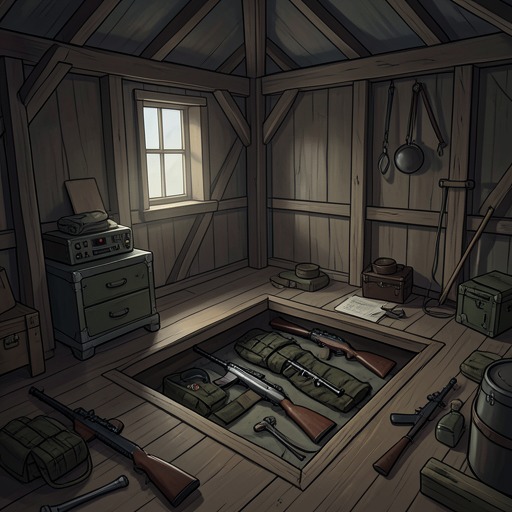
Jane Searches and Seizes John’s Secret Arsenal
Mr. & Mrs. SmithJane’s search of John’s tool shed exposes the domestic secret at the center of their marriage: beneath the clutter and suburban normality lies a vast, carefully concealed arsenal. She finds weapons of many kinds and piles of cash, then orders her team to carry everything away in pillowcases and sheets. The seizure is both a practical raid and a reversal of the Smiths’ hidden power: Jane enters the space John has kept to himself and makes its contents hers to remove.
Two private territories
The discovery follows a sharp contrast between the spouses’ domestic domains. Jane describes the kitchen as her territory, learned through necessity during childhood: she had to prepare her own food or go without, and brought the same drive for perfection to cooking that she applied elsewhere. John’s territory, by contrast, is the tool shed. She had paid little attention to what he kept there or how often he went inside, though in retrospect his visits had been frequent. Now that Jane believes John has left, that previously overlooked space becomes a place to search for something valuable.
The episode’s earlier image of Jane’s kitchen helps frame the discovery. She has concealed her own special equipment beneath the oven: streamlined weapons and polished knives, clean, oiled, and ordered. Since John cannot even boil water, she judged the kitchen a convenient place to hide secrets. Her cache makes clear that concealment is not uniquely John’s practice; each spouse has adapted familiar household space to a covert life. The difference is that Jane’s weapons are arranged in a domain she controls, while John’s larger secret waits beneath the shed floor.
Finding the hidden room
Inside the shed, Jane encounters disorder rather than the orderly professional equipment she expects from herself. She opens toolboxes and rummages through drawers without knowing what most of the objects are. Then the floor answers her footsteps with a hollow echo. She laughs at the discovery of a false floor, stamps to confirm the sound, and recognizes that she has found the principal vein of John’s secret. A flashlight turns the unfamiliar shed into a search site.
The concealment is substantial but not secure enough to withstand Jane’s expertise. John has shut the cache away, yet she moves an object resembling a workbench and finds a safe set into the floor. Combination locks are among her specialties, so she opens it quickly, locates a lever, and enters through the trapdoor. The hidden construction transforms an ordinary outbuilding into a vertical passage to a private armory—and makes the supposedly safe suburban home part of the couple’s operational world.
Below, weapons of every size and kind hang along the walls. Shelves hold stacks of banknotes in different denominations and foreign currencies, enough to make the local bank branch’s vault seem small by comparison. Jane’s first reaction is astonishment; her next is pleasure. What had looked like an unpleasant chore—cleaning out a tool shed—has yielded a consequential prize. The money broadens the discovery beyond a weapons stash: John has concealed resources as well as the means to use force.
Seizure and exposure
Jane’s colleagues arrive and are as astonished as she is. Her response is immediate and practical: everything is to be put into bags. The team packs John’s weapons and carries them up the ladder, using pillowcases and sheets as improvised wrapping. Outside, Jane watches with satisfaction as her operatives load a black van. The everyday linens disguise the removal of an extraordinary cache, preserving the contrast between the quiet suburban street and the covert operation unfolding on it.
The neighboring children briefly bring that contrast into view. Jane smiles as two girls pass and ask what is happening to Mrs. Smith. The question addresses her by her domestic identity while the weapons leave John’s shed in bulk. The scene does not show the girls learning what the van contains; instead, their innocent presence underscores how little the neighborhood’s surface reveals about the Smiths’ home.
Domestic space as operational cover
The shed raid sits within a recurring pattern in which weapons are concealed inside ordinary fixtures and objects. Jane uses the oven to hide her own knives and weapons; John hides an arsenal beneath the shed; elsewhere, a concealed wall panel in Jane’s personal room yields a silenced pistol, while apparent office walls open to reveal rocket launchers. At the Home-Made store, the couple arrive with shopping bags full of weapons, and John later retrieves two guns from a box labeled for model trains. These recurrences make domestic and commercial objects part of the agents’ equipment, with familiar appearances serving as camouflage.
That pattern is also the episode’s marital reversal. Jane had assumed the tool shed was merely John’s separate territory and had not asked what he did there. Once she reads its floor as a clue, she converts his private domain into evidence and inventory. The seizure does not resolve the larger conflict between the spouses, but it makes their shared predicament concrete: each has been living beside another person’s hidden weapons, hidden money, and hidden professional competence, with ordinary household life masking the scale of what has been kept out of view.